| statementID | statementDescription |
|---|
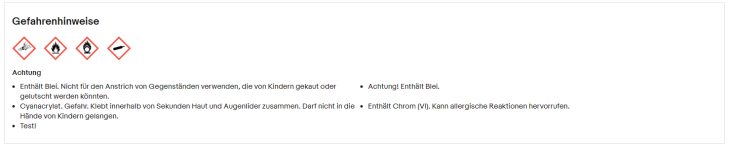
| EUH201 | Contains lead. Should not be used on surfaces liable to be chewed or sucked by children. |
| EUH201A | Warning! Contains lead. |
| EUH202 | Cyanoacrylate. Danger. Bonds skin and eyes in seconds. Keep out of the reach of children. |
| EUH203 | Contains chromium (VI). May produce an allergic reaction. |
| EUH204 | Contains isocyanates. May produce an allergic reaction. |
| EUH205 | Contains epoxy constituents. May produce an allergic reaction. |
| EUH206 | Warning! Do not use together with other products. May release dangerous gases (chlorine). |
| EUH207 | Warning! Contains cadmium. Dangerous fumes are formed during use. See information supplied by the manufacturer. Comply with the safety instructions. |
| EUH209 | Can become highly flammable in use. |
| EUH209A | Can become flammable in use. |
| EUH210 | Safety data sheet available on request. |
| EUH401 | To avoid risks to human health and the environment, comply with the instructions for use. |
| H200 | Unstable explosives. |
| H201 | Explosive; mass explosion hazard. |
| H202 | Explosive, severe projection hazard. |
| H203 | Explosive; fire, blast or projection hazard. |
| H204 | Fire or projection hazard. |
| H205 | May mass explode in fire. |
| H220 | Extremely flammable gas. |
| H221 | Flammable gas. |
| H222 | Extremely flammable aerosol. |
| H223 | Flammable aerosol. |
| H224 | Extremely flammable liquid and vapour. |
| H225 | Highly flammable liquid and vapour. |
| H226 | Flammable liquid and vapour. |
| H228 | Flammable solid. |
| H229 | Pressurised container: May burst if heated. |
| H240 | Heating may cause an explosion. |
| H241 | Heating may cause a fire or explosion. |
| H242 | Heating may cause a fire. |
| H250 | Catches fire spontaneously if exposed to air. |
| H251 | Self-heating: may catch fire. |
| H252 | Self-heating in large quantities; may catch fire. |
| H260 | In contact with water releases flammable gases which may ignite spontaneously. |
| H261 | In contact with water releases flammable gases. |
| H270 | May cause or intensify fire; oxidiser. |
| H271 | May cause fire or explosion; strong oxidiser. |
| H272 | May intensify fire; oxidiser. |
| H280 | Contains gas under pressure; may explode if heated. |
| H281 | Contains refrigerated gas; may cause cryogenic burns or injury. |
| H290 | May be corrosive to metals. |
| H300 | Fatal if swallowed. |
| H301 | Toxic if swallowed. |
| H302 | Harmful if swallowed. |
| H304 | May be fatal if swallowed and enters airways. |
| H310 | Fatal in contact with skin. |
| H311 | Toxic in contact with skin. |
| H312 | Harmful in contact with skin. |
| H314 | Causes severe skin burns and eye damage. |
| H315 | Causes skin irritation. |
| H317 | May cause an allergic skin reaction. |
| H318 | Causes serious eye damage. |
| H319 | Causes serious eye irritation. |
| H330 | Fatal if inhaled. |
| H331 | Toxic if inhaled. |
| H332 | Harmful if inhaled. |
| H334 | May cause allergy or asthma symptoms or breathing difficulties if inhaled. |
| H335 | May cause respiratory irritation. |
| H336 | May cause drowsiness or dizziness. |
| H340 | May cause genetic defects. |
| H341 | Suspected of causing genetic defects. |
| H350 | May cause cancer. |
| H351 | Suspected of causing cancer. |
| H360 | May damage fertility or the unborn child. |
| H361 | Suspected of damaging fertility or the unborn child. |
| H362 | May cause harm to breast-fed children. |
| H370 | Causes damage to organs. |
| H371 | May cause damage to organs. |
| H372 | Causes damage to organs through prolonged or repeated exposure. |
| H373 | May cause damage to organs through prolonged or repeated exposure. |
| H400 | Very toxic to aquatic life. |
| H410 | Very toxic to aquatic life with long lasting effects. |
| H411 | Toxic to aquatic life with long lasting effects. |
| H412 | Harmful to aquatic life with long lasting effects. |
| H413 | May cause long lasting harmful effects to aquatic life. |